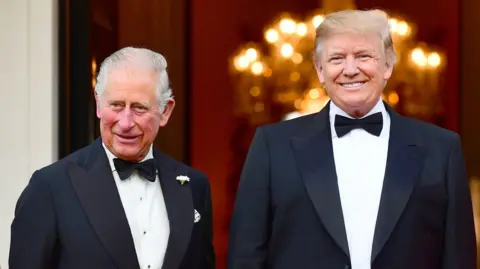
When King Charles III stepped onto American soil during a state visit hosted by Donald Trump, few expected a quiet but pointed message on governance to ripple across political circles. The moment wasn’t defined by grand speeches or policy announcements, but by a calibrated warning: unchecked executive power threatens democratic foundations. At a time of rising populism and centralized authority, the British monarch—ceremonial head of a constitutional system—used subtle diplomacy to underscore a universal truth: power must be balanced.
This wasn't a lecture. It was a contrast—one lived, not declared.
A Royal Visit
with Unspoken Tension
The backdrop was ceremonial: red carpets, military honors, and state dinners. Yet beneath the surface, the meeting of Trump and Charles represented a clash of governing philosophies. One, an elected leader known for bypassing norms, leveraging executive orders, and challenging institutional constraints. The other, a sovereign bound by law, precedent, and accountability to Parliament.
Charles did not name names. He didn’t need to.
In a keynote address at a joint congressional reception, he spoke of “the enduring necessity of checks and balances,” calling them “the quiet guardians of liberty.” He praised the U.S. Constitution’s design but reminded listeners that “instruments of governance only endure when their constraints are respected, not circumvented.”
These words, measured and diplomatic, landed with quiet force. Legal scholars and political analysts noted the timing: the U.S. was amid debates over emergency declarations, impeachment proceedings, and the scope of presidential authority. Charles’ remarks, though framed as a tribute to democratic ideals, were interpreted as a gentle rebuke.
Why a Monarch’s Words Carry Weight
It’s ironic that a king—one whose role is symbolic—would speak on limiting power. But that’s precisely why it resonates. Charles operates within a system that deliberately neutered royal authority centuries ago. The UK’s evolution from absolute to constitutional monarchy offers a living case study in how power can be safely distributed.
Unlike Trump, who often positioned himself as a disruptor of the “swamp,” Charles embodies continuity through constraint. He cannot veto laws, command armies, or influence policy directly. His influence comes through counsel, visibility, and moral suasion—not decree.
This contrast is instructive. When a figure with real power uses it expansively, and one with symbolic power urges restraint, the message flips the script on legitimacy. It suggests that true leadership isn’t measured by how much control one wields, but by how responsibly it’s held.
Executive Power in the Trump Era: A Pattern of Expansion
During his presidency, Trump pushed the boundaries of executive authority in ways that alarmed constitutional experts:
- Emergency declarations to fund border walls after congressional denial
- Removal of inspectors general without clear cause or Senate input
- Use of social media to announce policy shifts, bypassing official channels
- Attempts to influence the Justice Department in high-profile cases
Legal scholars like Laurence Tribe and Cass Sunstein warned that these moves, while not always illegal, eroded norms essential to separation of powers. Norms, unlike laws, aren’t enforceable in court—but they’re the glue holding democratic systems together.
Charles’ remarks didn’t reference these incidents directly. But in a broader sense, he highlighted what happens when norms fray: institutions weaken, public trust declines, and polarization deepens.
The Constitutional Monarchy as a Mirror
The British system, for all its anachronisms, institutionalizes limits. The monarch reigns but does not rule. Prime ministers govern, but are accountable to Parliament. The judiciary operates independently.
This isn’t accidental. The Glorious Revolution of 1688 decisively shifted power from crown to parliament. Centuries later, the UK’s uncodified constitution relies on convention as much as law—much like the U.S. system.
But where the U.S. has seen a steady accretion of presidential power—especially since the Cold War—the UK has moved toward greater devolution and transparency. The Fixed-term Parliaments Act (repealed in 2022 but indicative of intent), freedom of information laws, and judicial review mechanisms reflect an institutional skepticism of concentrated authority.
Charles, as heir and now sovereign, has witnessed this evolution. His advocacy for environmental and social causes is well known, but always conducted within nonpartisan bounds. He doesn’t lobby. He doesn’t pressure. He models restraint.
Diplomacy as a Tool for Democratic Advocacy
Monarchs rarely wade into political debate. Yet soft diplomacy—especially from constitutional figures—can shape discourse without overstepping.
Charles’ approach mirrored that of Queen Elizabeth II, who once broke precedent to speak on national unity during times of crisis. His comments weren’t interventionist; they were reflective. By praising the U.S. system’s design while underscoring its vulnerabilities, he reminded Americans of their own ideals.
This kind of messaging works because it comes from a neutral party. A foreign leader criticizing Trump might be dismissed as partisan. A British king, bound by neutrality, carries moral authority precisely because he wields no power.
Other world leaders have used similar tactics. Germany’s presidents often invoke historical lessons on democracy. Scandinavian royals promote civic values through public engagement. But Charles’ intervention stood out due to the host: a U.S. president known for testing institutional limits.
What Checks and Balances Actually Look Like
Abstract praise for “checks and balances” means little without concrete mechanisms. Here’s how they function—and where they falter:
| Check | Purpose | Recent U.S. Challenge |
|---|---|---|
| Judicial Review | Courts can overturn unconstitutional executive actions | Delays in litigation allow policies to take effect before being struck down |
| Congressional Oversight | Legislators investigate and constrain executive overreach | Partisan gridlock often prevents effective scrutiny |
| Free Press | Media holds leaders accountable | Accusations of “fake news” undermine public trust in reporting |
| Civil Service | Nonpartisan officials implement policy consistently | Political appointments and purges threaten institutional integrity |
| Public Opinion | Citizens demand accountability through elections and protest | Polarization reduces shared factual baseline |
Charles’ message implied that these mechanisms only work when leaders accept their legitimacy. When a president attacks judges, dismisses Congress as “irrelevant,” or undermines the press, the system creaks.
The UK isn’t immune—Boris Johnson’s clashes with Parliament over Brexit showed similar strains. But the key difference? No British PM can rule by fiat. When Johnson tried to prorogue Parliament in 2019, the Supreme Court stopped him. No such immediate check exists in the U.S. system for many presidential actions.
The Risk of Symbolism Without Action

Critics argue that royal commentary, however well-intentioned, changes little. Charles can’t force reforms. He can’t vote. His influence is cultural, not political.
And yet, cultural influence shapes politics. When leaders normalize restraint, it raises the cost of overreach. When institutions are publicly affirmed, they gain resilience.
Consider the aftermath of Charles’ visit: U.S. editorial boards referenced his remarks in critiques of executive overreach. Law schools used the moment in constitutional law seminars. The conversation shifted—not because a king commanded it, but because his position lent clarity.
This is the power of symbolic leadership: to reframe, not dictate.
A Lesson in Leadership Beyond Power
The image endures: Trump, accustomed to dominating headlines, hosting a king who quietly outmaneuvered him in the court of public discourse. One projected strength through dominance. The other, strength through humility.
Leadership isn’t just about making decisions. It’s about modeling behavior. Charles didn’t accuse. He reminded. He didn’t challenge Trump directly. He appealed to a shared framework—one that both nations, in theory, uphold.
In an age of spectacle, his message was a quiet correction: democracy survives not through strongmen, but through systems. Not through loyalty to a person, but to principles.
Closing: What We Can Learn from the Contrast
The royal visit wasn’t about policy. It was about precedent. King Charles’ remarks on executive power matter not because they changed laws, but because they re-centered a vital conversation.
For citizens, the takeaway is clear: vigilance isn’t partisan. It’s patriotic. Whether you support a leader or not, unchecked power endangers everyone.
So ask: - Does this action respect institutional boundaries? - Is it transparent and accountable? - Would it stand scrutiny over time?
Hold leaders—elected or symbolic—to the same standard: not how much they can do, but how well they uphold the system that allows them to lead.
Power restrained is power respected.
FAQ
Did King Charles directly criticize Donald Trump? No, Charles did not mention Trump by name. His comments were framed as general support for democratic principles, but their timing and context were widely interpreted as a subtle critique.
Can a British monarch comment on foreign politics? Traditionally, monarchs avoid overt political statements. However, they may speak on broad values like democracy and rule of law, especially in diplomatic settings.
What are checks and balances? They are mechanisms—like judicial review, legislative oversight, and free press—that prevent any one branch of government from becoming too powerful.
How did the U.S. media react to Charles’ remarks? Reactions were mixed. Some praised his statesmanship; others dismissed it as royal overreach. But many legal and political analysts acknowledged the validity of his concerns.
Has the British monarchy influenced political discourse before? Yes. Queen Elizabeth II made rare public statements during constitutional crises. Royal figures often use ceremonial roles to reinforce national values.
What limits presidential power in the U.S.? Congress can pass laws, control funding, and impeach. The courts can rule executive actions unconstitutional. Public opinion and elections also serve as checks.
Why is executive overreach dangerous? It undermines democracy by concentrating power, eroding trust, and weakening institutions designed to protect rights and ensure accountability.
FAQ
What should you look for in King Charles Warns on Executive Power in Trump-Era Visit? Focus on relevance, practical value, and how well the solution matches real user intent.
Is King Charles Warns on Executive Power in Trump-Era Visit suitable for beginners? That depends on the workflow, but a clear step-by-step approach usually makes it easier to start.
How do you compare options around King Charles Warns on Executive Power in Trump-Era Visit? Compare features, trust signals, limitations, pricing, and ease of implementation.
What mistakes should you avoid? Avoid generic choices, weak validation, and decisions based only on marketing claims.
What is the next best step? Shortlist the most relevant options, validate them quickly, and refine from real-world results.